Brachytherapy
Everything to know about brachytherapy
Brachytherapy: specialized radioactive sources for precise ocular tumor treatment
It involves sealed radioactive sources (Iodine-125 or Ruthenium-106), custom-designed episcleral plaques, precise surgical positioning techniques, as well as dosimetry planning systems, radiation shielding infrastructure, continuous dose monitoring equipment, and strict radioprotection protocols requiring specialized hospital facilities.
Brachytherapy uses sealed radioactive sources, typically in the form of episcleral plaques, surgically positioned against the external wall of the eye at the tumor site. These sources emit low-energy radiation that penetrates ocular tissues over a limited distance, thus concentrating the dose in the tumor zone.
The principle relies on the inverse square law: radiation intensity decreases rapidly with distance from the source. This physical characteristic provides a highly advantageous dose gradient, with maximum tumor irradiation and minimal exposure of distant structures such as the contralateral optic nerve or orbital tissues.
The isotopes used in ocular brachytherapy emit two main types of radiation with distinct properties:
- Photon radiation (gamma and X-ray): massless particles that penetrate deeply into tissues with progressive attenuation
- Particulate radiation (beta): high-energy electrons with limited penetration and abrupt stopping in tissues
- Half-life
- Emission
- Dose rate
Iodine-125 (I-125)
- Half-life 59.4 days
- Emission Photons
- Dose rate Moderate
Ruthenium-106 (Ru-106)
- Half-life 373 days
- Emission Electrons
- Dose rate High
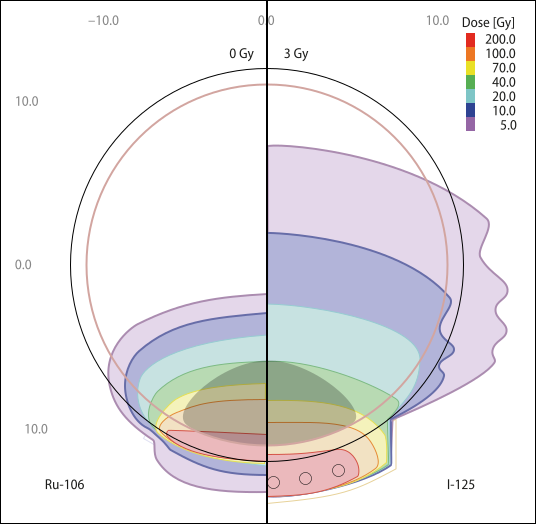
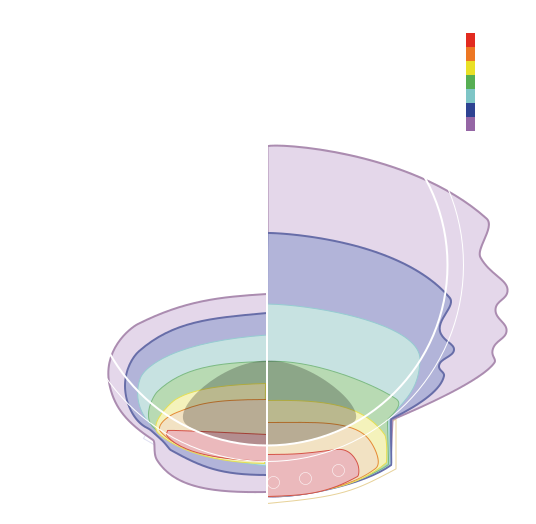
Choice of plaque type in ocular brachytherapy: Ruthenium-106 vs. Iodine-125
The selection of the isotope is based not only on plaque shape or availability, but more importantly on the dosimetric characteristics of each source—specifically, how deeply the radiation penetrates into tissue. As a beta emitter whose particles have a limited range in tissue (a few millimeters), Ruthenium-106 is ideal for treating small or moderately thick tumors, typically less than 5–6 mm in height. Its shallow penetration allows for precise irradiation of the tumor while sparing deeper structures of the eye, such as the macula or optic nerve, when they are not directly involved. In contrast, as a gamma emitter with radiation that penetrates more deeply into tissue, Iodine-125 is better suited for larger or thicker tumors (generally greater than 5–6 mm) or tumors located close to critical structures, where full tumor coverage is necessary. However, its deeper penetration also means a greater volume of surrounding tissue is irradiated, which may increase the risk of long-term side effects. In summary, the two plaque types are not interchangeable, as they do not deliver equivalent radiation doses at depth. Choosing the appropriate plaque is a critical dosimetric decision, tailored to each patient, to maximize treatment effectiveness while minimizing complications.
Pre-operative planning
Precise dosimetric planning is crucial:
- Multimodal imaging: ultrasound, OCT, angiography to precisely define tumor contours
- Dosimetric calculation: 3D modeling to optimize plaque positioning
- Prescribed dose: typically 85-100 Gy to tumor apex
Surgical procedure
Implantation is performed under general or regional anesthesia:
- Tumor localization: precise localization by transillumination or intraoperative ultrasound
- Plaque positioning: episcleral fixation with non-absorbable sutures
- Verification: positioning and geometry control
- Closure: watertight conjunctival suture
Hospitalization and radioprotection
Hospital management differs according to the isotope used:
- Iodine-125: mandatory hospitalization in lead-lined room (2-7 days) with strict radioprotection measures for staff and visitors
- Ruthenium-106: hospitalization also required in shielded room (2-4 days) but generally less strict radioprotection constraints due to the beta nature of the radiation
During implantation:
- Ophthalmologic surveillance: daily monitoring of the treated eye
- Dosimetry: continuous dose rate verification
- Complication management: symptomatic treatment if necessary
- Visit restrictions: time and distance limitations for relatives