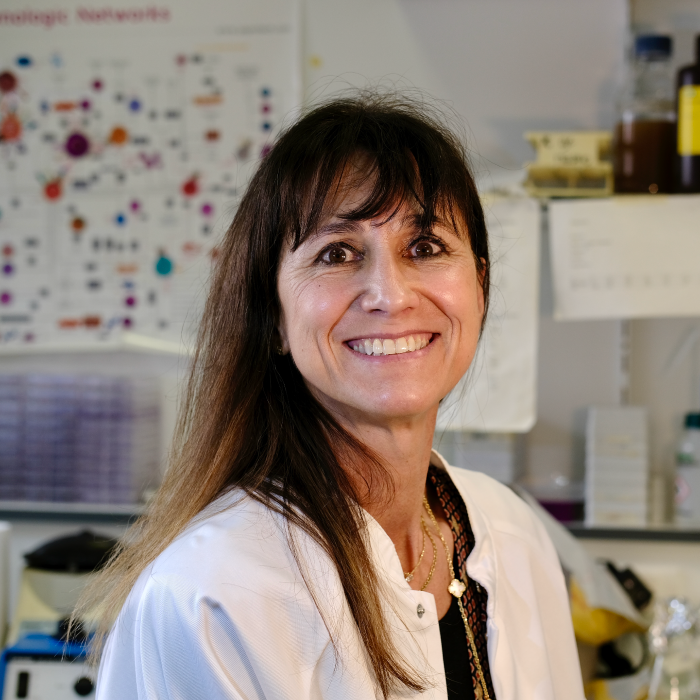
Corine Bertolotto
Researcher
Corine Bertolotto is a Research Director at the Mediterranean Center for Molecular Medicine (C3M), part of Université Côte d’Azur. She co-leads a research team with Robert Ballotti, focusing on ocular and cutaneous melanomas. She chairs one of the National Expert Committees of the Ligue contre le Cancer.
Short Bio
Understanding the biology of cancer is fundamental to advancing healthcare. This is the focus of Corine Bertolotto's research into the molecular mechanisms involved in the progression of skin and eye melanoma, two highly aggressive tumors with a median survival rate of just a few months once they have metastasized.
The team she co-directs with Robert Ballotti at the C3M at the Université Côte d'Azur aims to develop innovative translational research to bring about new diagnostic and therapeutic concepts that are useful in the clinical field of melanoma but can also be transposed to other cancers. To meet these expectations, her team is studying the molecular mechanisms involved in ocular melanoma and searching for clinically exploitable vulnerabilities.
Finally, recognition of her expertise in oncology has led her to sit on the board of directors of the International Federation for Research on Pigment Cells, from which melanomas originate, on the specialized scientific committee of the Ligue contre le Cancer, and to serve as vice president of the Département d'Onco-Ophtalmologie Niçois (DOON).
Career path
- Research Scientist (1999–2008) at INSERM (U145)
- Senior Research Scientist (2009–2012) at INSERM (U385)
- Senior Research Scientist (2012–2017), Team 1, at INSERM (U1065)
- Co-Team Leader (2018–today), Team 1, at INSERM (U1065)
Education
- PhD in Life and Health Sciences (1998) at University of Nice Sophia Antipolis, Nice
- Accreditation to Supervise Research (HDR) (2006) at University of Nice Sophia Antipolis, Nice
Publications
Publications: 128
Citations: 8,285 by 6,341 publications
h-index: 51
ORCID: https://orcid.org/0000-0001-6971-7753
- Proteau S, Krossa I, Husser C, Guéguinou M, Sella F, Bille K, Irondelle M, Dalmasso M, Barouillet T, Cheli Y, Pisibon C, Arrighi N, Nahon-Estève S, Martel A, Gastaud L, Lassalle S, Mignen O, Brest P, Mazure NM, Bost F, Baillif S, Landreville S, Turcotte S, Hasson D, Carcamo S, Vandier C, Bernstein E, Yvan-Charvet L, Levesque MP, Ballotti R, Bertolotto C, Strub T. LKB1-SIK2 loss drives uveal melanoma proliferation and hypersensitivity to SLC8A1 and ROS inhibition. EMBO Mol Med. 2023;15(12):e17719. doi: 10.15252/emmm.202317719
- Patton EE, Mueller KL, Adams DJ, Anandasabapathy N, Aplin AE, Bertolotto C, Bosenberg M, Ceol CJ, Burd CE, Chi P, Herlyn M, Holmen SL, Karreth FA, Kaufman CK, Khan S, Kobold S, Leucci E, Levy C, Lombard DB, Lund AW, Marie KL, Marine JC, Marais R, McMahon M, Robles-Espinoza CD, Ronai ZA, Samuels Y, Soengas MS, Villanueva J, Weeraratna AT, White RM, Yeh I, Zhu J, Zon LI, Hurlbert MS, Merlino G. Melanoma models for the next generation of therapies. Cancer Cell. 2021;39(5):610-631. doi: 10.1016/j.ccell.2021.01.011
- Pandiani C, Strub T, Nottet N, Cheli Y, Gambi G, Bille K, Husser C, Dalmasso M, Béranger G, Lassalle S, Magnone V, Pédeutour F, Irondelle M, Maschi C, Nahon-Estève S, Martel A, Caujolle JP, Hofman P, LeBrigand K, Davidson I, Baillif S, Barbry P, Ballotti R, Bertolotto C. Single-cell RNA sequencing reveals intratumoral heterogeneity in primary uveal melanomas and identifies HES6 as a driver of the metastatic disease. Cell Death Differ. 2021;28(6):1990-2000. doi: 10.1038/s41418-020-00730-7
- Bellini L, Strub T, Habel N, Pandiani C, Marchetti S, Martel A, Baillif S, Bailly-Maitre B, Gual P, Ballotti R, Bertolotto C. Endoplasmic reticulum stress mediates resistance to BCL-2 inhibitor in uveal melanoma cells. Cell Death Discov. 2020;6:22. doi :10.1038/s41420-020-0259-2
- Bertolotto C, Lesueur F, Giuliano S, Strub T, de Lichy M, Bille K, et al. A SUMOylation-defective MITF germline mutation predisposes to melanoma and renal carcinoma. Nature. 2011;480(7375):94-98. doi:10.1038/nature10539