Orbital tumors
All you need to know about orbital tumors
The orbit is a rigid bony cavity in which the eye is the largest structure. Orbital tumors can arise from any tissue within the orbit: muscle, nerve, bone, blood vessels, or lacrimal gland. Intraocular tumors, sinus tumors, or even metastases can sometimes secondarily invade the orbit. They may be benign or malignant (cancerous). However, even benign tumors can have serious consequences as they may exert a local mass effect on the optic nerve and the eye, potentially leading to blindness.
Orbital tumors can manifest in different ways, with one or more clinical signs:
- exophthalmos (protruding eye, “bulging eye” appearance)
- binocular diplopia (double vision)
- pain, more commonly associated with malignant tumors
- decreased visual acuity
- palpable or protruding mass
In vascular tumors, exertion or certain positions may cause temporary enlargement of the lesion. Benign tumors usually progress slowly over months to years, whereas malignant tumors progress more rapidly over weeks to months.
A complete ophthalmologic examination with orbital imaging is essential for diagnosis, although in some cases a biopsy or surgical excision is required to confirm the diagnosis of an orbital tumor. The urgency depends on the nature of the lesion (benign tumor versus cancer) and on its functional impact on the eye and optic nerve (compression or not of the optic nerve).
Surgery is often recommended for orbital tumors. Its purpose may be solely diagnostic (biopsy) or therapeutic, aiming to remove the lesion partially or completely (biopsy-excision). Orbital surgeries are performed under general anesthesia and may be guided by intraoperative histopathological examination (frozen section analysis).
In cases of incomplete excision, repeat surgery or treatment with radiotherapy may be considered. Other treatments can be offered, either as an alternative or in addition to surgery. Proton therapy may be used in some cases where surgery cannot achieve complete excision. In orbital lymphoma, external beam radiotherapy or immunochemotherapy may be indicated. Very rarely, in particularly aggressive or recurrent cancers, radical surgery with orbital exenteration may be performed.
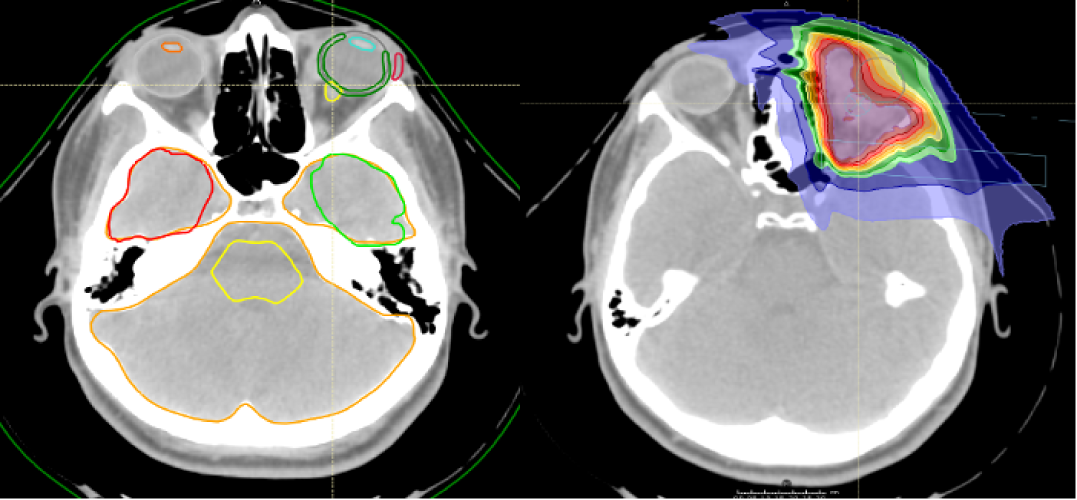
Example of a proton therapy treatment plan (high-energy proton beam delivered by a synchrocyclotron in France) for an orbital tumor. Each key organ (eye, optic nerve, brain) is delineated to minimize irradiation of these tissues.